

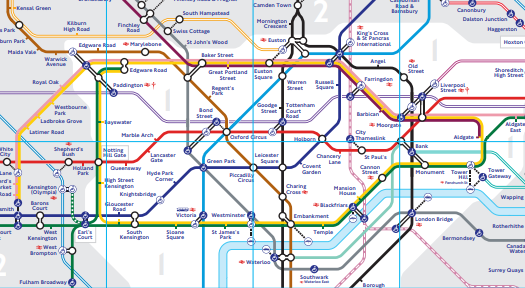
I was travelling on London’s Tube the other day when it struck me: I didn’t actually notice the design of the Underground map at all. It simply worked — clear, confident, and communicative. And that’s the point.
Harry Beck’s Underground map is a masterpiece of invisibility. Before him, designers tried to make it geographically accurate — a squiggly mess that mirrored the city above. It was precise, but utterly impractical.


Beck did something radical: he stopped telling the truth and started telling what mattered. He straightened the lines, spaced the stations evenly, and ignored geography altogether. And it worked — brilliantly. Because the real question wasn’t “How do I represent London accurately?” but “How do I help people get from A to B without losing their mind?”
That’s the paradox of good design: you only notice it when it’s bad.
Bad design shouts. It demands attention and energy.
Good design quietly removes friction until it disappears.
Think of it like manners. Bad design is the guest who won’t stop talking about himself. Good design is the one who quietly tops up your glass.
Not every brand has the confidence to disappear. But the ones that do earn something far more powerful than attention — they earn trust.
Good design doesn’t shout. Like the Tube map, it earns devotion by quietly doing its job well.
What’s a piece of design you love precisely because it disappears?