

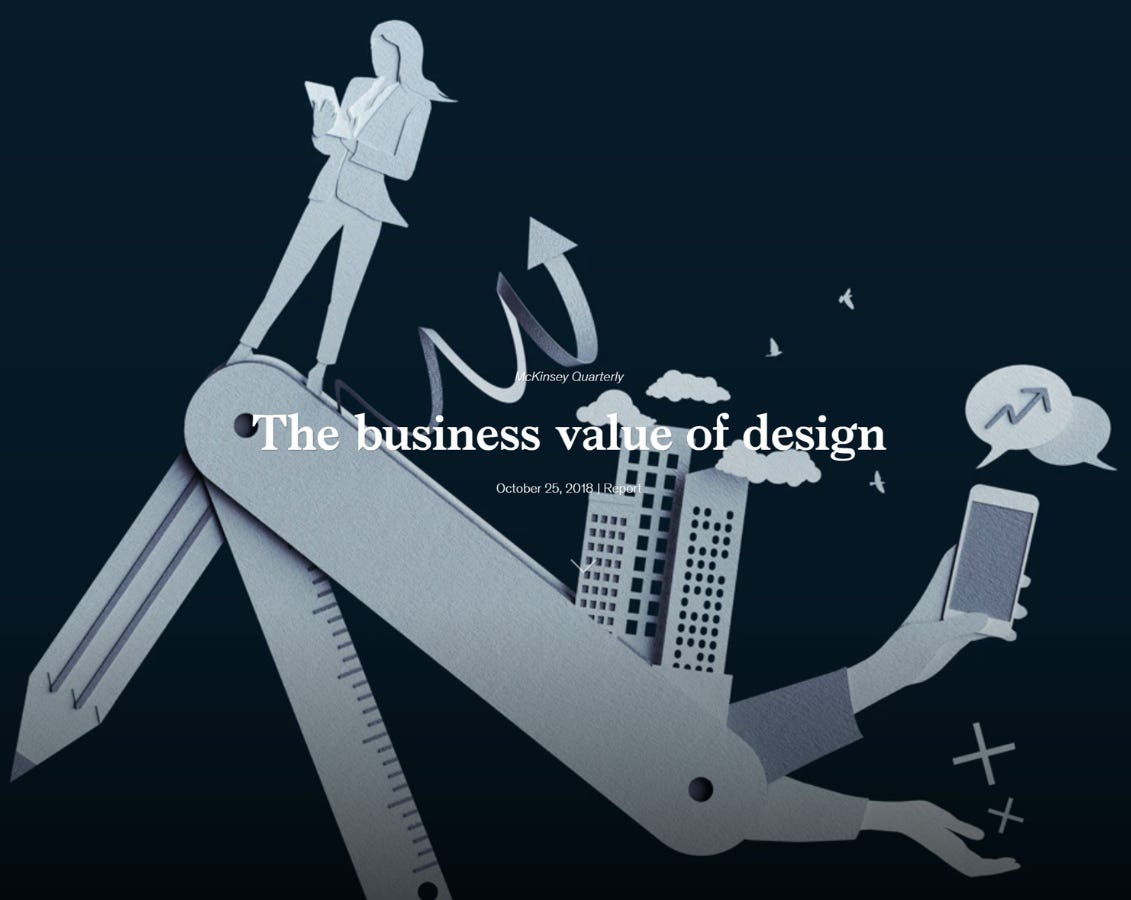
A few weeks ago, I revisited McKinsey's Business Value of Design report. I’d read it years ago and never forgot it. It has aged remarkably well. If anything, it feels even more relevant today.
McKinsey tracked 300 publicly listed companies over five years and found a simple truth: those that built design into their business's core outperformed peers 2-to-1 in both revenue growth and shareholder returns.
That’s not a creative opinion. It's a commercial fact.
I realise that most companies don’t practice design — they perform it. Decorating the outcome instead of integrating the design process. McKinsey’s research offers six reasons why this still happens.
1. Design is treated as decoration, not direction
Design is often seen as ‘making things look nice’ instead of shaping strategy. A last-mile polish, not a first-mile driver.
2. Unmeasurable = unbelievable
Leaders don’t see design as measurable. Fewer than 5% of firms said their leaders make objective design decisions. Without metrics to prove design’s impact, it feels ‘subjective’ compared to finance or ops.
3. It’s siloed and sidelines, not integrated
Design sits in a corner, a department that gets ‘briefed’ — rather than a capability embedded across product, service, and experience. Limiting its strategic influence.
4. Short-termism kills it
Good design needs iteration, testing and patience. If businesses optimise for quarterly results, its compounding benefits remain invisible.
5. No seat at the table
Few have design leaders reporting to the C-suite. Without senior representation, design’s voice gets muted by louder functions: finance, sales, marketing, ops etc.
6. Confusing theatre with capability
Many confuse ‘design thinking workshops’ with design capability. Real design builds research loops, prototypes and feedback mechanisms that improve outcomes over time.
McKinsey’s data makes one thing clear: the companies that outperform don’t just have better designers — they’ve built the right environment for design to thrive.
They do a few simple things differently:
1. They measure design with the same rigour as cost & revenue
2. They embed design in cross-functional teams, not isolated studios
3. They treat customer insight as a boardroom issue
4. They iterate like their survival depends on it, because it does
When you do this, design stops being decoration. It becomes direction. Design doesn’t just make things look better, it makes them work better. The smartest firms realise the design's true value and don’t treat it like a garnish added at the end, but a core ingredient that shapes the whole dish.
So here’s the uncomfortable question:
Does your business still decorate its strategy — or does it design it?
You can find the report link HERE